Prednisolone for Children: A Parent's Complete Dosing Guide
Learn when prednisolone is prescribed for children, how weight-based dosing works for asthma, croup, and nephrotic syndrome, and what side effects to expect from a short course.
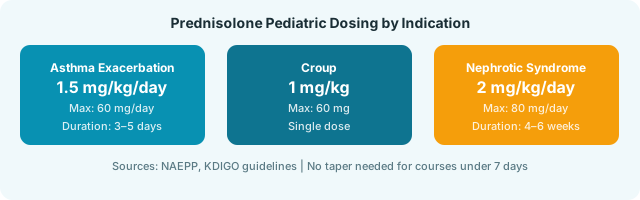
Quick Answer: Prednisolone is a corticosteroid prescribed for pediatric asthma exacerbations (1.5 mg/kg/day, max 60 mg, 3–5 days), croup (1 mg/kg single dose, max 60 mg), and nephrotic syndrome (2 mg/kg/day, max 80 mg). Short courses under 7 days don't require tapering and rarely cause significant side effects.
If your child was just prescribed prednisolone liquid and you're not sure what to expect, this guide covers what it is, why the dose is based on weight, how to measure it accurately, and what side effects are common versus concerning.
What Is Prednisolone?
Prednisolone is a synthetic corticosteroid — a drug that mimics cortisol, a hormone your body produces naturally, but at much higher doses than the body makes in normal conditions. At pharmacological doses, it reduces inflammation and suppresses immune responses. This is why it's useful for asthma exacerbations (inflamed airways), croup (swollen subglottic airway), and nephrotic syndrome (an immune-mediated kidney condition).
Prednisolone is the active form of prednisone. In children, prednisolone is generally preferred over prednisone because it doesn't require hepatic conversion before becoming active — an important consideration in young children whose liver enzyme pathways are still developing. It's also available as a palatable oral liquid in two concentrations: 15 mg/5 mL (3 mg/mL) and 25 mg/5 mL (5 mg/mL).
Why the Dose Depends on Your Child's Weight
Corticosteroids follow the same weight-based dosing principles as other pediatric medications. The therapeutic effect scales with body mass, so a 10 kg toddler and a 30 kg 8-year-old need very different amounts. The prednisolone pediatric dose calculator calculates the correct dose for each indication based on current guidelines.
The indication matters as much as the weight. Prednisolone for asthma is typically prescribed at 1.5 mg/kg/day (NAEPP guideline range: 1–2 mg/kg), while nephrotic syndrome uses 2 mg/kg/day per KDIGO protocol. Selecting the wrong indication in the calculator — or being given the wrong one by a prescriber — produces a meaningfully different dose.
Dosing for the Three Most Common Indications
Asthma Exacerbation
The National Asthma Education and Prevention Program (NAEPP) recommends 1–2 mg/kg/day of prednisolone for acute asthma exacerbations, with most clinicians targeting approximately 1.5 mg/kg/day. The maximum is 60 mg/day. Course length is typically 3–5 days. No taper is needed for courses under 7 days.
For a 20 kg child: 1.5 × 20 = 30 mg/day. Once daily in the morning. Using the 15 mg/5 mL (3 mg/mL) formulation: 30 ÷ 3 = 10 mL. Using the 25 mg/5 mL (5 mg/mL) formulation: 30 ÷ 5 = 6 mL. The volume depends on which concentration your pharmacy dispensed — check the bottle.
Croup
For croup (viral laryngotracheitis), prednisolone is given as a single 1 mg/kg dose, maximum 60 mg. Some protocols repeat this dose once at 24 hours if symptoms persist. Dexamethasone 0.6 mg/kg is more commonly used for croup now (single oral dose, longer duration of action), but prednisolone is used when dexamethasone isn't available or when a liquid corticosteroid is preferred. See the dexamethasone pediatric dose calculator if dexamethasone is what was actually prescribed.
For a 15 kg child with croup: 1 × 15 = 15 mg as a single dose. Using 3 mg/mL: 5 mL. Using 5 mg/mL: 3 mL.
Nephrotic Syndrome
Nephrotic syndrome induction therapy per KDIGO guidelines uses 2 mg/kg/day, maximum 80 mg/day, for 4–6 weeks, followed by a tapering protocol. This is a much longer course than the asthma or croup scenarios above, and it will be managed by a pediatric nephrologist. The dose in the calculator reflects the induction phase; the tapering schedule is customized by the specialist.
How to Measure and Give the Dose
Prednisolone liquid has a somewhat sweet, slightly medicinal taste. Most children accept it, especially the newer flavored formulations. If your child resists, it can be mixed with a small amount (5–10 mL) of juice or flavored drink. Don't mix it into a full cup of juice — if the child doesn't finish the drink, they don't get the full dose.
Use an oral dosing syringe — the pharmacy should provide one. Don't use a kitchen teaspoon. Measure at eye level with the syringe held vertically; the liquid meniscus bows slightly, and you read at the bottom of the curve.
Give the dose in the morning when possible. Prednisolone can disrupt sleep if given in the evening, and morning administration also better mimics the body's natural cortisol peak.
Side Effects: What's Normal for a Short Course
For courses of 3–7 days, side effects are usually mild and temporary:
- Increased appetite: Very common. Children often become noticeably hungrier. This resolves when the course ends.
- Mood changes: Irritability, hyperactivity, or mood swings are reported by many parents. More pronounced in some children than others. This also resolves quickly.
- Sleep disruption: Difficulty falling asleep or staying asleep, particularly if the dose is given in the afternoon or evening.
- Stomach upset: Less common but possible. Giving with food helps.
These effects are expected and don't warrant stopping the medication early, which would leave the underlying condition undertreated.
What to Watch For (Call the Doctor)
- Signs of a serious allergic reaction: hives, swelling, difficulty breathing
- High fever during the course — prednisolone suppresses immune responses and can mask early infection signs
- Significant blood in stools (rare but possible with high doses)
- A child who seems dramatically worse on the medication, rather than improved
About Long-Term Side Effects
The side effects most people associate with steroids — weight gain, growth suppression, bone density changes, immune suppression — are associated with long-term, high-dose use over months or years, not with 3–7 day courses. A short course of prednisolone for a viral-trigger asthma episode or croup does not meaningfully affect growth or bone density. The benefit of treating the acute condition far outweighs the risk.
If your child requires frequent courses of oral corticosteroids — say, more than 3–4 courses per year — that's a conversation to have with your pediatrician about underlying disease management, but it's not a reason to withhold a medically indicated short course.
Checking Your Child's Dose
Before giving any dose, use the prednisolone pediatric dose calculator to verify the mL volume on the prescription matches the calculation for your child's current weight and the dispensed concentration. Errors are rare but do happen — a quick cross-check takes 30 seconds and provides peace of mind.