Antibiotics for Kids: Which Drug, When, and How Much
A practical guide to the most commonly prescribed pediatric antibiotics — Augmentin, cefdinir, azithromycin, clindamycin, and more — with dosing principles and when each is used.
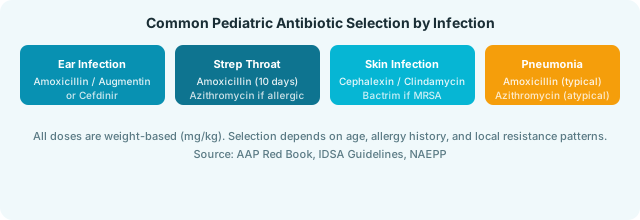
Quick Answer: The most commonly prescribed pediatric antibiotics are amoxicillin-clavulanate (Augmentin), cefdinir, azithromycin, and cephalexin. Which one your child receives depends on the type of infection and local resistance patterns. All are dosed by weight (mg/kg) with published maximum dose caps.
Pediatric antibiotics aren't interchangeable. A drug that works for a strep throat doesn't necessarily work for a complicated ear infection, and the dose that's correct for a 10 kg toddler is wrong for a 30 kg child — even for the same medication. This guide covers the antibiotics you'll most likely encounter at a pediatric visit and explains how to think about dose calculations.
The Most Common Pediatric Antibiotics and What They Treat
Amoxicillin-clavulanate (Augmentin)
Augmentin combines amoxicillin with clavulanate, a beta-lactamase inhibitor that expands coverage to include amoxicillin-resistant organisms. It's first-line for otitis media (ear infections) in children who've recently had amoxicillin, sinusitis, bite wounds, and some skin infections.
Dosing is based on the amoxicillin component at 40–90 mg/kg/day depending on the indication and local resistance patterns, divided into two doses. The 90 mg/kg/day regimen is reserved for high-risk ear infections (children under 2, daycare attendance, recent antibiotic exposure). Maximum dose is generally 875 mg of amoxicillin per dose, or 1,750 mg/day. Use the Augmentin pediatric dose calculator to get the per-dose mL volume for the dispensed suspension concentration.
Cefdinir
Cefdinir is a third-generation cephalosporin used for ear infections, strep throat, sinusitis, and mild skin infections. It's often prescribed when Augmentin isn't tolerated due to diarrhea (a common side effect of the clavulanate component).
Standard dosing is 14 mg/kg/day as a single daily dose or divided into two doses. Maximum is 600 mg/day. A distinctive feature: cefdinir can turn stools reddish-orange when taken with iron-containing products or formula, which alarms parents but isn't harmful. The cefdinir dosage calculator handles the concentration-to-volume conversion for both the 125 mg/5 mL and 250 mg/5 mL suspensions.
Azithromycin (Z-Pack equivalent)
Azithromycin is a macrolide antibiotic used for community-acquired pneumonia, Mycoplasma infections, pertussis (whooping cough), and chlamydia. It's also used as a penicillin alternative for strep throat in children with severe penicillin allergy.
Dosing for pneumonia follows a 5-day course: 10 mg/kg on day 1 (max 500 mg), then 5 mg/kg on days 2–5 (max 250 mg). For strep throat as a penicillin alternative, it's 12 mg/kg/day for 5 days (max 500 mg/day). The azithromycin pediatric dose calculator handles both indications and converts to mL for the standard 200 mg/5 mL suspension.
Cephalexin
Cephalexin (Keflex) is a first-generation cephalosporin used for uncomplicated skin and soft tissue infections — impetigo, cellulitis, infected eczema — and as a step-down for strep throat after injection. It's active against streptococci and methicillin-susceptible Staphylococcus aureus, though not against community-acquired MRSA.
Dosing is 25–50 mg/kg/day divided every 6–12 hours, maximum 4 g/day. The cephalexin pediatric dose calculator computes the dose and volume for the 125 mg/5 mL and 250 mg/5 mL suspensions.
Bactrim (trimethoprim-sulfamethoxazole)
Bactrim is used for urinary tract infections, community-acquired MRSA skin infections, Pneumocystis pneumonia prophylaxis, and some gastrointestinal infections. It's dosed based on the trimethoprim component: 8–12 mg/kg/day of TMP divided every 12 hours, with a maximum of 320 mg TMP/day (160 mg per dose).
Bactrim has a long list of drug interactions and is contraindicated in infants under 2 months and in patients with sulfa allergy. The Bactrim pediatric dose calculator applies the TMP-component dosing and flags max-dose caps.
Clindamycin
Clindamycin covers gram-positive organisms including MRSA and anaerobes. It's used for deep skin infections, osteomyelitis, dental abscesses, and pelvic infections in adolescents. Oral dosing is 10–30 mg/kg/day divided every 6–8 hours, maximum 1.8 g/day (300–450 mg per dose depending on severity). The clindamycin pediatric dose calculator applies severity-based dose ranges.
How to Choose Between Them
Antibiotic selection isn't arbitrary. The prescriber is matching the drug to the likely pathogen, accounting for local resistance patterns, checking for allergies, and weighing side-effect profiles.
For uncomplicated ear infections in an otherwise healthy child with no recent antibiotics: amoxicillin alone (not Augmentin) is still first-line per AAP guidelines. For recurrent ear infections or treatment failure: Augmentin. For the child with persistent diarrhea on Augmentin: cefdinir. For suspected atypical pneumonia in a school-age child: azithromycin. For a skin infection in a community with high MRSA rates: clindamycin or Bactrim.
Don't request a specific antibiotic unless you have a clinical reason. Each drug has a different resistance-inducing potential, and broad-spectrum antibiotics used unnecessarily drive resistance patterns that affect all children.
Why the Weight Still Matters Even When the Drug Is Familiar
Parents who've given Augmentin before sometimes assume the dose is the same as last time. It often isn't, because children grow. A child who was 14 kg at age 2 may be 19 kg at age 3 — a 35% increase that changes a 40 mg/kg dose from 560 mg/day to 760 mg/day. Always recalculate at each prescription, not just the first one.
Use our pediatric antibiotic dose calculators with the current weight each time. Match the concentration to the dispensed bottle. And if the prescription label's per-dose volume differs materially from the calculator's output, call the pharmacist before the first dose.
Course Duration Matters Too
Stopping antibiotics early when the child feels better is one of the most common medication errors in pediatrics. Most antibiotic courses are 5–10 days; stopping at day 3 because symptoms improved leaves a subtherapeutic concentration in the tissues that can select for resistant organisms.
Finish the full course unless the prescriber tells you to stop early (which sometimes happens if cultures return and the drug doesn't cover the identified organism). Throw away unused antibiotic; reconstituted suspension degrades and shouldn't be stored for future use.