Augmentin vs Cefdinir for Kids: Choosing the Right Antibiotic
Augmentin and cefdinir are both used for pediatric ear infections and sinusitis. Learn the key differences in spectrum, side effects, dosing frequency, and when your child's doctor might choose one over the other.
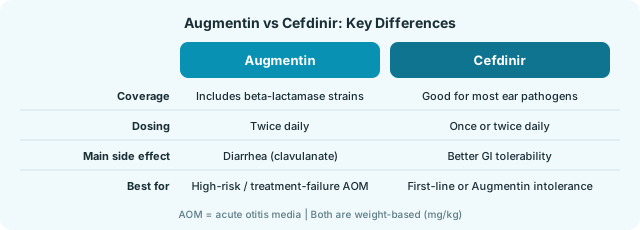
Quick Answer: Augmentin (amoxicillin-clavulanate) covers beta-lactamase-producing bacteria that cefdinir doesn't, making it first-line for treatment-failure ear infections and some sinusitis cases. Cefdinir is preferred when diarrhea from Augmentin is a problem. Both are dosed by weight; dosing frequency differs.
If your child has been prescribed one of these two antibiotics and you're wondering what the difference is — or if the pharmacy substituted one for the other — here's what you need to know.
The Core Difference: What Each Drug Covers
Both Augmentin and cefdinir are beta-lactam antibiotics active against Streptococcus pneumoniae and Haemophilus influenzae, the two most common bacterial causes of otitis media (ear infections) and sinusitis in children.
The key difference is Augmentin's clavulanate component. Clavulanate inhibits beta-lactamase — an enzyme that many bacteria produce to destroy penicillin-type drugs. Strains of Haemophilus and Moraxella catarrhalis that produce this enzyme are resistant to amoxicillin alone but are knocked out by Augmentin. Approximately 30–40% of Haemophilus isolates in North America produce beta-lactamase.
Cefdinir is a third-generation cephalosporin that has reasonable stability against many beta-lactamases, but it's not identical in spectrum to Augmentin. It covers most ear infection pathogens well, but for high-risk cases — treatment failure, recent antibiotics, a child under 2 with bilateral ear infection — Augmentin at the higher dose is the AAP-recommended choice.
When Augmentin Is Preferred
The American Academy of Pediatrics 2024 otitis media guidelines recommend amoxicillin (or Augmentin if amoxicillin alone has already failed) as initial therapy. Augmentin specifically is recommended over plain amoxicillin when:
- The child has received amoxicillin in the past 30 days
- The child has concurrent purulent conjunctivitis (which suggests Haemophilus)
- There's a history of recurrent ear infections not responding to amoxicillin
For sinusitis, Augmentin is often preferred outright when antibiotic therapy is indicated, because beta-lactamase-producing organisms are common causative agents.
Dosing for high-risk ear infections uses the 90 mg/kg/day regimen of the amoxicillin component, which requires using the higher-concentration suspension (600 mg/5 mL or equivalent). Use the Augmentin pediatric dose calculator with the indication set to "severe/high-risk" to get this dose.
When Cefdinir Is Preferred
Cefdinir's main advantage is tolerability. Augmentin's clavulanate component commonly causes:
- Diarrhea (in up to 20–30% of children)
- Loose stools and cramping
- Nausea, particularly at the 90 mg/kg dose
When a child can't tolerate Augmentin's GI side effects, or when the family reports poor adherence due to diarrhea, cefdinir is a reasonable second-line choice. It's also convenient for once-daily dosing — cefdinir can be given as a single 14 mg/kg dose once daily (max 600 mg), which improves compliance compared to Augmentin's twice-daily schedule.
Cefdinir is also useful for children with a documented non-severe penicillin allergy. Because it's a cephalosporin (a different beta-lactam class), cross-reactivity with penicillin allergy is low — historically cited at around 1–2%, though more recent data suggests this is even lower.
Use the cefdinir dosage calculator to find the correct dose and mL volume for your child's weight using the dispensed suspension concentration.
Dosing Comparison
For a 20 kg child with an ear infection:
Augmentin (standard, 40 mg/kg/day):
- Daily dose: 40 mg/kg × 20 kg = 800 mg/day amoxicillin component
- Twice daily: 400 mg per dose
- Using 400 mg/5 mL suspension: 5.0 mL per dose
Augmentin (high-risk, 90 mg/kg/day):
- Daily dose: 90 mg/kg × 20 kg = 1,800 mg/day → capped at 1,750 mg/day
- Twice daily: 875 mg per dose
- Using 600 mg/5 mL suspension: 7.3 mL per dose
Cefdinir (14 mg/kg/day):
- Daily dose: 14 mg/kg × 20 kg = 280 mg/day
- Once daily: 280 mg
- Using 250 mg/5 mL suspension: 5.6 mL per dose
The once-daily option for cefdinir is genuinely easier for many families, especially for school-age children where the midday dose is hard to administer.
Side Effects to Know About
Augmentin: Diarrhea is the main issue, driven by clavulanate's effect on gut flora. Giving it with food reduces GI side effects. Adding a probiotic (Lactobacillus rhamnosus GG, specifically) during the course has good evidence for reducing antibiotic-associated diarrhea and can be worth doing if your child has a history of problems.
One distinctive Augmentin side effect parents sometimes worry about: the suspensions can cause dark or greenish stools from unabsorbed drug. This isn't concerning.
Cefdinir: Lower rate of GI side effects overall. The main concern parents notice is reddish-orange stools when cefdinir is taken close in time to iron-containing formula or iron supplements — this is from an insoluble iron-cefdinir chelate and isn't medically significant. Separate cefdinir from iron by at least 3 hours if possible.
What to Do If the Pharmacy Substitutes One for the Other
Pharmacies sometimes substitute within an antibiotic class for supply reasons. If cefdinir was prescribed and the pharmacy dispenses cefuroxime, or vice versa, call the prescribing clinician. The same drug class doesn't mean identical spectrum or dosing. The cefuroxime pediatric dose calculator can help you check the dose if cefuroxime is what was actually dispensed.
Don't give one drug's dose with another drug's formulation — the concentrations are different, so the mL volume will be wrong.
The Bottom Line
Augmentin or cefdinir isn't a question of one being "stronger" — it's a question of which spectrum is needed and which the child can tolerate. For high-risk or treatment-failure ear infections, Augmentin at 90 mg/kg/day is the guideline-based choice. For straightforward infections or when diarrhea is a problem, cefdinir offers good coverage with once-daily convenience.
If you're not sure which was prescribed or want to verify the volume in the syringe, run the dose through the appropriate calculator with your child's current weight and the exact concentration on the dispensed bottle.