Why Your Child's Weight Changes Their Medication Dose
Children are dosed by weight, not age. Learn why mg/kg dosing matters, how max-dose caps work, and why a 10 kg toddler and a 35 kg child get very different amounts of the same drug.
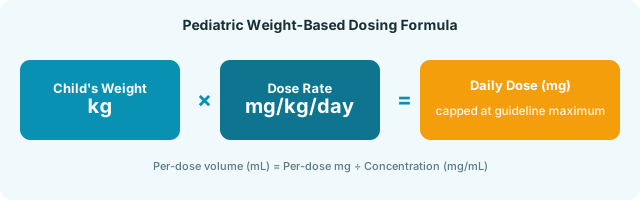
Quick Answer: Pediatric medication doses are calculated by multiplying the child's weight in kilograms by the drug's target dose rate (mg/kg). This accounts for differences in metabolism and clearance between small children and older kids. The same drug at the same mg/kg dose is safe and effective across a wide age range; a flat dose based on age alone is not.
You filled the prescription, read the label, and the volume in the syringe looks surprisingly small — or surprisingly large. If you've ever wondered why a pharmacist asks for your child's weight just to dispense an antibiotic, this article explains exactly how weight-based dosing works and why it matters.
Why Children Can't Use Adult Doses
Drugs are eliminated from the body primarily through the liver (metabolism) and kidneys (excretion). In adults, these systems are essentially mature and stable, so a fixed dose — say, 500 mg of amoxicillin — works for most people above a certain body weight.
In children, the picture is more complicated. A 6 kg infant has a liver that's approximately 3–4% of body weight, roughly double the adult ratio by weight. Hepatic enzyme activity, renal glomerular filtration rate, and plasma protein binding all change during the first years of life and continue evolving through adolescence. A drug that clears in 4 hours in a 10 kg toddler might clear in 6 hours in a 5 kg infant — same drug, very different pharmacokinetics.
Weight-based dosing accounts for this by tying the dose to body mass. When every child's dose is expressed as mg per kg, the calculation automatically adjusts for the differences in distribution and clearance that come with size.
What mg/kg Actually Means
The notation "mg/kg/day" means milligrams of drug per kilogram of body weight per day. If a guideline recommends 40 mg/kg/day for Augmentin (amoxicillin-clavulanate) in a mild ear infection, the calculation for a 15 kg child is straightforward:
- Daily dose: 40 mg/kg × 15 kg = 600 mg/day
- If given twice daily: 300 mg per dose
- Using 250 mg/5 mL suspension: 300 ÷ 50 mg/mL = 6.0 mL per dose
The Augmentin pediatric dose calculator does this in one step. But understanding the math helps you catch errors when they happen.
How Maximum Dose Caps Protect Heavier Children
Weight-based dosing works well until a child's calculated dose exceeds the adult maximum. A 50 kg teenager on 40 mg/kg/day of amoxicillin-clavulanate would calculate to 2,000 mg/day — well above the standard adult maximum of 875–1,750 mg/day depending on the indication. Past a certain dose, more drug doesn't mean more efficacy; it means more side effects.
Every well-designed pediatric dose calculator applies a published maximum dose cap. The cap comes from the same guidelines that set the mg/kg rate. For most drugs, once the weight-based dose would exceed the adult maximum, the child simply receives the adult dose. Our calculators show a clear warning when this cap is applied, so you know the dose wasn't simply calculated by weight.
This is important: if you see a max-dose warning and re-enter a lower weight to avoid it, you're underdosing the child. The cap is deliberate.
Why Age Alone Isn't Enough
"Children under 2: half a tablet. Children 2–5: one tablet." You've seen instructions like this on over-the-counter products. For most prescription medications, this approach is inadequate.
A 2-year-old can weigh anywhere from 9 to 14 kg depending on their growth trajectory. A 10-year-old can range from 25 to 45 kg. Age-based dosing assigns the same amount to children at the extremes of that range — under-dosing heavier children (subtherapeutic concentrations, treatment failure) and potentially over-dosing lighter ones.
The American Academy of Pediatrics and every major pediatric prescribing reference use weight-based dosing for all drugs where the effective dose scales with body size. For drugs that don't scale with weight — like some antivirals where a fixed dose covers a wide weight range — the label will specify. But for antibiotics, steroids, antiemetics, and antacids, weight is the right input.
Getting the Weight Right
An accurate weight matters at least as much as the dose calculation. Children's weight changes rapidly — a child who weighed 14 kg at their 18-month check-up may weigh 16 kg by their next prescription, a 14% increase that changes the dose meaningfully.
Weigh the child in kilograms on a calibrated scale, ideally undressed or in minimal clothing. If you're at home without a pediatric scale, a bathroom scale can work: weigh yourself, then weigh yourself holding the child, and subtract. This is accurate to within about 0.5 kg for most bathroom scales, which is acceptable for children over 10 kg.
Never round up "to be safe." The max-dose cap handles the upper safety limit. Rounding a 14.2 kg child to 15 kg adds a small amount of extra drug with no therapeutic benefit, and for narrow-therapeutic-index drugs, it matters.
The Role of Concentration Selection
Once you have the correct mg dose, you need to convert it to a volume of liquid. This depends on the concentration of the suspension — expressed as mg/mL or as mg/5 mL on the label.
The same drug can come in multiple concentrations. Using the wrong concentration in your calculation gives you the right mg dose on paper but the wrong volume in the syringe. Our pediatric dose calculators include a concentration selector for exactly this reason — match it to the bottle in your hand, not to whatever the default option is.
Measure liquid doses with an oral dosing syringe, not a kitchen spoon. Teaspoons vary from 3.5 to 6 mL depending on the spoon, which represents a 70% variance at the extremes. A 1 mL or 5 mL oral syringe, properly read at eye level with the syringe held vertically, is accurate to within 0.1–0.2 mL.
A Note on Neonates and Premature Infants
The calculators on this site are validated for children generally weighing 1 kg and above, covering the typical pediatric outpatient population. Neonatal dosing — especially for preterm infants — involves additional variables: post-menstrual age, serum creatinine, bilirubin displacement, and immature hepatic enzyme pathways. If you're working with a neonate, use a dedicated neonatal formulary (NeoFax, the BNF for Children) and consult a neonatologist or clinical pharmacist. Our tools are not designed for that population.
Putting It Together
Weight-based dosing isn't complicated once you understand the logic. The formula is simple; the nuances are in getting the inputs right — an accurate weight, the correct indication, the right concentration, and the appropriate frequency. Use our weight-based pediatric dosing calculators to do the math, and use the result as a cross-check against the prescription label.
If the numbers don't match by more than 20%, call the pharmacist before giving the first dose. That gap is more often a concentration mix-up or a transcription error than a fundamental disagreement with the guideline — but it warrants a conversation either way.